By Frank
kadzakumanja
Experience in Africa has shown that
it has always been a challenge for farmers to know the right prices
for commodities hence they always sell their produce soon after
harvest at a very low price. On 23rd July, 2012
Agricultural Commodity Exchange (ACE) organized a two day training
course on price information for 13 enumerators from Chiradzulu,
Nsanje, Bangula, Namwera, Ntaja, Muloza, Mwanza, Neno, Nkhotakota,
Salima, Luchenza, Chikhwawa and Balaka at its head office in
Lilongwe. Agriculture is the mainstay of the economy of many
African countries including Malawi as nearly 85 percent of its
population derives livelihood from agriculture and if farmers know
the right price, they are able to sell at a higher price and
increase their profit which in turn improves their personal
income. With new Information and Communication Technologies
(ICT) development taking place, it is now key for agricultural
institutions to provide up to date knowledge and information about
agricultural technologies, markets, price trends and consumer
preferences.
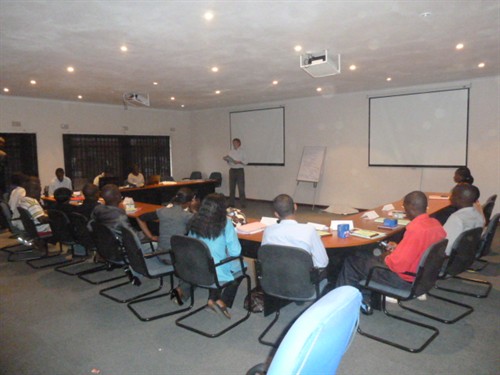 Principal Advisor for ACE
K.Moller giving his speech
Principal Advisor for ACE
K.Moller giving his speech
|
 Enumerators group photo with
their trainer R.Sibande(Deputy Chief of
Party-Market Linkages Initiative) and
E.Chamgwera(Trade Facilitation Manager-ACE) Enumerators group photo with
their trainer R.Sibande(Deputy Chief of
Party-Market Linkages Initiative) and
E.Chamgwera(Trade Facilitation Manager-ACE)
|
The objective of the training was
to equip enumerators with knowledge and skill to collect market
prices from different markets using the esoko technology on mobile
phones. Speaking during the training, deputy chief of party for
Market Linkages Initiative (MLI) Rachel Sibande said that this
technology will help farmers make well informed decisions about
when to sell their commodities and when to buy at a reasonable
price. Among other things, Enumerators were asked to do role plays
on how they would sell the value proposition of Esoko and sign up a
trader or smallholder farmer onto Esoko to receive price alerts.
After the training, Agriculture commodity Exchange (ACE) principal
advisor Kristian Schach Moller presented certificates of attendance
to the enumerators and encouraged them to do the good job of
obtaining prices so that farmers make better decisions as regards
to when or where to sell or buy their commodities.