An ACE way to play the market...
By Georgina Smith
As the doors swing open at the
Nathenje warehouse, the maize harvest is neatly stacked up in white
bags and rested on clean wooden logs. It's a very different
spectacle to last year, when a few bags of maize were stashed in
the corner of the dilapidated building, weevil-infestedand
testament to yet another post-harvest loss. The refurbishment of
the old warehouse and the brand new one built next door is part of
an ambitious expansion plan by the Agricultural Commodity Exchange
(ACE),which started trading in 2006, to roll-outreceipt certified
warehouses across the country.
Outside, farmers gather to share
their experiences of playing the commodity market for the first
time. "If I didn't have my maize here, I would have sold it to a
vendor for a much lower price - around MK40 (US$0.12)," said Nivson
Stock, one of four farmers to deposit his maize. "The best thing
was I got 70 percent of the value of the maize," he said. With
grain accounted for in quality and quantity by ACE, banks will lend
70 percent of thevalue - MK248,500 (US$755)in Stock's case -
against thedeposited asset.
|
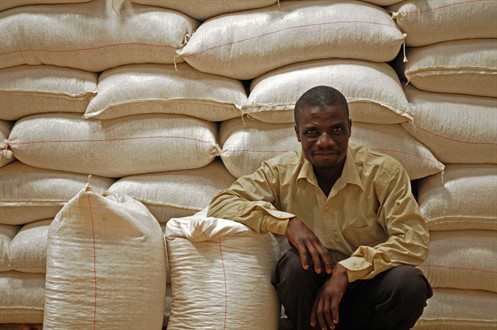
Mr Nivison Stock Deposited 7.01 MT at Nathenje
Warehouse
|
 Nathenje
Warehouse Nathenje
Warehouse
|
Without this initial finance, Stock
admits that school fees would have gone unpaid; the field would
remain un-ploughed and he would have to turn down labour
preparations for next season. It's true that maize prices could
drop while Stock's maize is still in the warehouse, and he will
lose money. But, he adds,"ACE keeps me up to date with the prices
in town." And given the glut of maize on the market after harvest,
holding onto it until leaner periodsis more likely to pay off.
Sure enough, it has. Stock has just
secured a contract with the World Food Programme for7.1Mt of maize
at MK77(US$0.23) per Kg, compared with MK50 (US$ 16) per Kg when he
deposited the grain in the warehouse, and made a profit ofMK114,877
(US$350) after warehouse fees and storage costs. He can either
re-invest in the next season, or purchase more maize and deposit
it. Although ACE's priority remains encouraging farmers to deposit
their own maize, this double-profit element is an exciting new
development pioneered by the Exchange, allowing farmers to become
savvy traders.
Sowing the seeds of
trust
Yet despite its successes, Nathenje
warehouse is only filled to a fraction of its capacity. Just
120kmaway, the Kafulu warehouse -another of three warehouses
constructed and managed by ACE - is by contrast full. Kafulu
Farmer's Association (KAFA) has about 1,000 farmers who deposited
in the warehouse, with others clamouring for space. Speculation has
begun on the reasons for the Kafulu success versus the relatively
small deposits at Nathenje.
As the average farmer has between
2-3 acres to farm, it is key that farmers bulk their deposits, so
building trust among local communities is essential. Peter Tamani,
warehouse manager at Nathenje, made this point: "Farmers
welcomed the concept but they don't see the value of the system
yet. They don't get along - they think one person will run off with
the money. Now we are looking at increasing sensitisation, so
farmers can see with their own eyes that this is real," he
said.
Putting the future of
farmers first
It is ACE's aim that eventually,
the warehouses will be self-sustaining, and plans for ten new
warehouses are already underway.For that reason, charges are
applied for storage, fumigation and staffing costs and the Exchange
takes a commission for handling, buying and selling transactions.
Although costs and charges have been explained and apparently
understood by farmers who have deposited their maize, it remains to
be seen how the wider community will react once they are
applied.
There is no doubt that ACE's
warehouse receipt system has come a long way. From three receipts
on maize last year, 80 have been traded this year. ACE has also
offered additional services to boost production, providing seed and
fertilisers for example, the cost of which will be deducted from
the farmer's profit when the commodity is sold. The challenge
will be sustaining awareness and
trust.Kristian Schach Moller, ACE's
Principal Advisor, admits that communication with the farmers has
been a challenge. "Do they really understand the costs? When we
deduct MK13,000(US$39) from their overall earnings will they
understand?," he asks.
Schach Molleris
certainly optimistic."We have three rural sites in operation and
I'm really happy that we're already exceeding 5,000Mt. My vision is
to have the warehouse receipt as the way to trade grain in Malawi,"
he said. "We have a long way to go, but I expect us to be at
20,000Mt next year," he added. Eventually, farmer associations will
manage their own warehouses, putting the success of the
entiresystem in their own hands - from sowing to trading.